

A data-driven look at technology adoption speeds and what history tells us about AI
By David Lederman | Gems Business Solutions Published: November 2025 | Reading Time: 10 minutes
Every major technology follows the same pattern: slow start, rapid acceleration, universal adoption. But here’s what should concern you: each new technology reaches critical mass faster than the last.
AI is being adopted faster than any technology in business history. And if you’re not moving now, you’re already behind.
The Acceleration Pattern
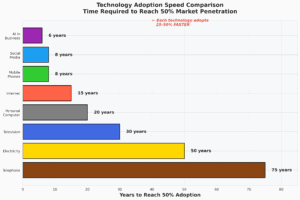
Look at these numbers:
- Telephone: 75 years to 50% adoption
- Electricity: 50 years
- Television: 30 years
- Personal Computer: 20 years
- Internet: 15 years
- Smartphones: 8 years
- AI in Business: 6 years
Each technology adopts 25-50% faster than the one before it.
From 75 Years to 5 Days
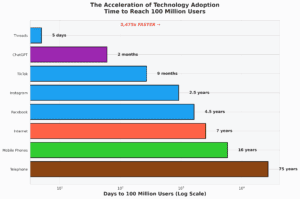
Time to reach 100 million users:
- Telephone: 75 years
- Internet: 7 years
- Facebook: 4.5 years
- Instagram: 2.5 years
- TikTok: 9 months
- ChatGPT: 2 months
- Threads: 5 days
That’s a 5,475x acceleration in adoption speed.
Where AI Stands Today
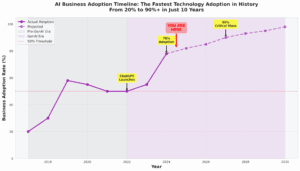
The data doesn’t lie:
- 2017: 20% of businesses using AI
- 2022: ChatGPT launches, everything changes
- 2024: 78% adoption ← WE ARE HERE
- 2027: 90% projected
- 2030: 95-98% projected
Just 6 years from 20% to 50%. That’s the fastest business technology adoption in recorded history.
You Are Here: The Critical Window
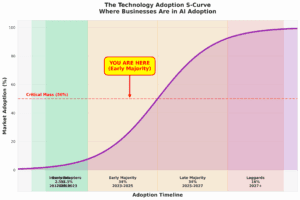
We’re in the Early Majority phase—the steepest part of the adoption curve. This is the last window for competitive advantage.
AI crossed 50% adoption in 2023. Once technology hits this critical mass, the remaining businesses adopt rapidly because the cost of NOT adopting becomes unbearable.
AI vs. Every Other Technology
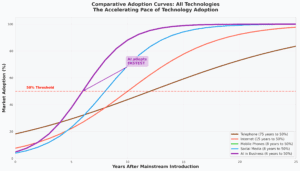
This chart tells the complete story. AI’s curve is the steepest. The timeline is the shortest. The window of opportunity is the narrowest.
The Three Windows: Where Do You Stand?
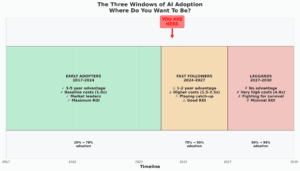
Window 1: Early Adopters (2017-2024)
3-5 year competitive advantage. Baseline costs. Market leadership. Maximum ROI. This window is closing now.
Window 2: Fast Followers (2024-2027)
1-2 year advantage if you move quickly. 1.5-2.5x higher costs. Good ROI but playing catch-up. You have 2-3 years.
Window 3: Laggards (2027+)
No advantage. 4-8x higher costs. Fighting for survival. Minimal ROI. Don’t end up here.
Every Year You Wait Costs More
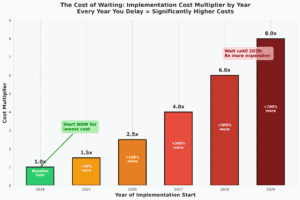
Implementation costs increase exponentially:
- 2024: 1.0x (baseline)
- 2025: 1.5x (+50%)
- 2026: 2.5x (+150%)
- 2027: 4.0x (+300%)
- 2029: 8.0x (+700%)
Why? Talent shortage. Competitive pressure. Lost opportunity cost. Market position erosion.
Competitive Advantage Evaporates
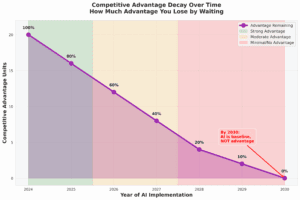
You lose approximately 20% of potential competitive advantage per year you delay.
By 2030, AI provides zero competitive advantage. It’s simply the baseline requirement to compete.
Having AI won’t make you special. NOT having AI will make you irrelevant.
Where Does Your Industry Stand?
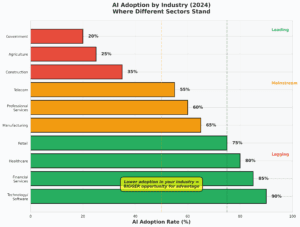
Current AI adoption by industry (2024):
- Leading: Technology (90%), Financial Services (85%), Healthcare (80%)
- Mainstream: Manufacturing (65%), Professional Services (60%)
- Lagging: Construction (35%), Agriculture (25%), Government (20%)
Key insight: Lower adoption in your industry = BIGGER opportunity for advantage. But that window is closing fast.
The Bottom Line
History is clear:
- Technology adoption is accelerating exponentially
- AI is being adopted faster than any technology in business history
- We’re at 78% adoption—the steepest part of the curve
- By 2027, 90% of businesses will use AI
- By 2030, AI provides no competitive advantage—it’s just table stakes
- Every year you wait costs 50-100% more to implement
- Every year you wait, you lose 20% of potential advantage
You have 2-3 years to act before AI becomes mandatory instead of advantageous.
In 1995, some businesses said: “We’ll build a website when the internet becomes more popular.” They went out of business.
In 2005, some businesses said: “We’ll start selling online when e-commerce matures.” They lost market share they never recovered.
In 2024, some businesses are saying: “We’ll implement AI when it’s more proven.”
They won’t survive until 2030.
Ready to Take Action?
The data is clear. The pattern is proven. The window is closing.
If you’re ready to implement AI but don’t know where to start, our comprehensive course provides everything you need:
AI Agents for Business: The Complete Implementation Guide
You’ll learn:
- How to assess your business and identify high-impact AI opportunities
- Step-by-step implementation frameworks that work
- Platform selection based on real-world data
- How to measure ROI and optimize performance
- Scaling strategies to expand AI across your operations
Or contact us directly for AI implementation services:
📧 info@businesswithgems.com
Gems Business Solutions
About the sources:
This analysis is based on data from McKinsey Global AI Surveys (2017-2024), Stanford AI Index (2025), IBM Global AI Adoption Index, Pew Research Center, U.S. Census Bureau, Our World in Data, and multiple peer-reviewed academic studies.